Digital Sovereignty: Can South Asia Control Its Technological Future?
South Asia must ask itself: Will the region be able to build its own technological sovereignty or will it be forced to be entirely dependent on external digital ecosystems?
COMMENTARIES
Thevindie Premarathne
7/28/2026


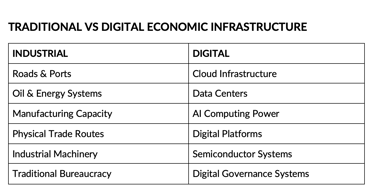
The foundation of modern economic power is shifting away from the more traditional industrial capability that determined it throughout much of the 1800s and 1900s. Today, technologies such as artificial intelligence and cloud computing now make up the largest economic forces instead.
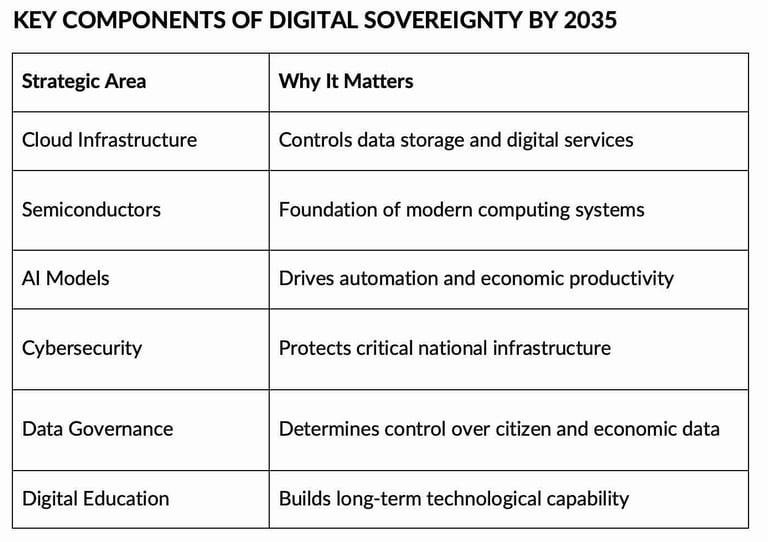
Both governments and corporations across the world have begun investing heavily in AI systems, semiconductor supply chains, cybersecurity frameworks, and digital infrastructure, and as the world’s economies become even more digitally integrated, the ability to control digital systems will continue to become a defining strategic advantage.
With this in mind, South Asia must ask itself: Will the region be able to build its own technological sovereignty or will it be forced to be entirely dependent on external digital ecosystems? A huge part of the region’s future economic competitiveness and long-term strategic autonomy may just depend on this answer.
THE NEW DIGITAL DEPENDENCY
South Asia’s digital transformation has accelerated rapidly over the last decade and continues to do so, with every aspect from public services to financial systems being increasingly digitized. Meanwhile, internet access and smartphone adoption rates continue to soar across the region. However, the majority of this digital growth does heavily rely on foreign digital infrastructure.
Most of South Asia remains dependent on foreign cloud providers, imported semiconductors and global digital platforms. While these technologies have accelerated economic connectivity and innovation, they have also created a new form of strategic dependency.
This dependence creates vulnerability with disruptions in semiconductor supply chains, cyberattacks targeting digital infrastructure, or restrictions on access to advanced computing systems, all having the potential to significantly affect entire South Asian economies and all their public services. This comes at a time where countries being more reliant on foreign-controlled platforms has raised important questions surrounding data governance and the privacy of citizens.
AI AND THE NEW ECONOMIC HIERARCHY
In recent years, artificial intelligence has increasingly begun to reshape the global economic hierarchy, and countries that have focused investment on advanced semiconductor production, massive data centers, high-performance cloud computing infrastructure, and the most advanced AI models may end up with significant long-term advantages in the emerging digital economy.
AI systems have begun to rapidly transform industries from manufacturing and logistics to finance to healthcare and education. These technologies have the potential to dramatically increase productivity and accelerate innovation, but these technologies may also concentrate economic power among countries that are capable of building and controlling this advanced digital infrastructure.
Nations that primarily import digital systems will become dependent on external ecosystems, while the countries that choose to develop their own domestic technological capabilities will be able to maintain their digital sovereignty.
For South Asia, this challenge is even more significant when the region’s growing digital ambitions and rapidly expanding economies are considered, yet without investment into the more advanced technological capabilities, the region risks becoming a mere consumer market for foreign technology while surrendering its digital sovereignty.
SOUTH ASIA’S OPPORTUNITY WINDOW
Despite all of these challenges, South Asia still possesses lots of opportunity to build its strategic digital capability over the coming decade like the majority of East Asia has over the preceding decade.
South Asia as a region is currently home to large youth populations, a young but emerging startup ecosystem, rapidly expanding digital economies, and growing pools of specialized technical talent. On top of that, across the region, digital services have already become major drivers of both economic growth and employment.
This is evident primarily in India, where an expanding technology ecosystem and investments into digital public infrastructure and fintech systems is starting to position the country as an increasingly important player in the global digital landscape.
Smaller economies in the region such as Sri Lanka also have the opportunity to position themselves strategically within these currently emerging digital ecosystems, focusing on specialized digital services and building effective regional systems that work alongside the already existing digital infrastructure.
DIGITAL GOVERNANCE AND DEMOCRACY
Going into the future, digital systems will only continue to become more and more deeply integrated into everyday life, and governance frameworks might become as important as the technology capability itself, with the risks surrounding surveillance, misinformation, algorithmic bias, and data privacy that come with digitalization.
With this, when governments adopt AI systems and digital public infrastructure, questions surrounding accountability and governance must be addressed proactively. For example, who should control the data of citizens? What about who will oversee automated decision-making systems? Or how should regional governments regulate AI without limiting innovation?
Failing to establish adaptive governance frameworks could risk the rights of citizens in pursuit of rapid digitalization and as such, balancing innovation with institutional safeguards will be one of the central governance challenges in the digital era.
BUILDING DIGITAL SOVEREIGNTY BY 2035
Within the next decade, digital infrastructure may become as important as ports and highways and energy systems were in earlier eras of economic development. For South Asia, the coming decade therefore represents an opportunity to determine whether the region will become an active participant in shaping the digital future, and to do this, the region must ensure its digital sovereignty is secured within the years to come.
Thevindie Premarathne is a Research Assistant(intern) for the Millennium Project’s South Asia Foresight Network (SAFN) in Washington, D.C. Edited by Sharon Bhattarai at NIICE Nepal.