Compliance to Foresight: How AI Is Transforming ESG Strategy by 2030
Looking at what's happening in Sri Lanka currently with Cyclone Ditwah causing widespread flooding and tragic loss of life, it's clear that ESG is no longer a future concern but must be considered a requirement in the present itself.
COMMENTARIES
Thevindie Premarathne
12/8/2025


Artist’s illustration of how machine learning is inspired by neuroscience (Google DeepMind)
Environmental, social, governance (ESG) considerations are taken lightly today but by 2030, considering ESG goals will no longer be a voluntary exercise in corporate responsibility but instead would play a key role in maintaining global competitiveness and regulatory compliance, with the severe impact of climate change looming. Looking at what's happening in Sri Lanka currently with Cyclone Ditwah causing widespread flooding and tragic loss of life, it's clear that ESG is no longer a future concern but must be considered a requirement in the present itself.
Meanwhile, the accelerating adoption of artificial intelligence (AI) is beginning to reshape how organizations plan, measure, as well as execute sustainability strategies. If organizations were to integrate AI into ESG strategies, entire industries would witness a shift towards predictive, real-time decision-making frameworks that can fundamentally transform how the entire world pursues long-term sustainability goals, from the organizations to governments and investors of all sizes. These capabilities would’ve had a direct impact on the number of lives lost in Sri Lanka recently as well, had Sri Lanka developed predictive AI systems with climate risk forecasting, the warning signals for Cyclone Ditwah would've been recognized a lot sooner, potentially reducing the number of casualties and enabling a more effective coordinated response.
As highlighted in the book "Global Governance of the Transition to Artificial General Intelligence: Issues and Requirements", the latest publication of Jerome C. Glenn, the founder of the Millennium Project, the world is entering an era in which AI systems become a core part of ensuring global safety and stability. Thus with this publication, the Millennium Project with its mission focused on global foresight is uniquely positioned to highlight how AI-augmented ESG systems have the capability to become the foundation for responsible innovation and a more resilient future as humanity enters the 2030s.
PREDICTIVE ESG ANALYTICS
While AI contributes to aligning organizations with ESG principles in many different ways, one of the most powerful methods is its ability to forecast future risks and opportunities based on past evidence. Predictive AI models can use a combination of historical data, satellite imagery, and climate projections to anticipate environmental changes that would threaten international supply chains, local infrastructure, or even whole communities. For example, predictive AI has the capability to estimate a company’s carbon emissions in its future operations under different scenarios, as well as its impact. Predictive AI could even estimate which resources would be limited due to climate change in the region before the climate change even occurs. This helps businesses adapt to changes before the government implements regulations or resource constraints force sudden shifts in company policy.
Sri Lanka's present crisis highlights the need for AI-augmented ESG vividly as well as predictive models would have been able to simulate rainfall accumulation based on the storm patterns and understand the risks of displacement caused by flooding, days before Sri Lanka was able to fully realize the risks, providing the local governments with actionable insights to mobilize evacuation procedures and protect critical infrastructure from the worst effects of the storm.
Organizations around the world are beginning to leverage predictive ESG analytics to be able to avoid creating stranded assets and to also reduce the costs of climate-related risks. According to Yahoo Finance, the global market for AI in ESG and sustainability is projected to grow from $182 billion in 2024 to $847 billion by 2032(USD), reflecting the increasing demand for AI-driven risk management tools as climate change begins to take its toll on environments across the globe. This trend specifically indicates that predictive analytics will soon be a requirement for organizations across the world, for both investors and executives alike, with the predicted 21.16% average growth in the market annually over the next 7 years.
REAL-TIME MONITORING & ADAPTING
Another one of AI’s most powerful contributions to achieving ESG goals is its ability to be able to turn reporting on data into a continuous process, rather than recording data with intervals in between. Instead of relying on annual disclosures and tracking progress once a year, systems augmented with AI allow companies to be able to track emissions, energy use, labor conditions, and resource efficiency in real time, with sensors in factors, farms, and supply chains, feeding live data into AI platforms, which can immediately flag problems and suggest actions to get the process back on track.
This capability reduces compliance burdens on organizations, with a better ability to ensure that regulations are adhered to constantly. As Reuters noted, U.S. regulators have raised concerns over the high costs of Europe’s ESG disclosure laws but these regulations are only expected to get stricter as climate change continues to escalate. By implementing AI-driven monitoring systems, organizations can lower these previously high costs by automating the corrective actions needed to consistently achieve ESG goals and therefore ensuring the organization constantly adheres to any regulation implemented by government bodies, both domestically and internationally.
Implementing these real-time ESG systems go beyond regulation with the use of ESG dashboards being a significant way companies could demonstrate accountability to both investors and consumers, using the transparency created to adhere to regulations into a competitive advantage to increase their market share.
As for Sri Lanka and the dozens of countries around the world that will also face challenges caused by climate change, these real-time monitoring systems have the ability to dramatically strengthen disaster response capabilities with Sri Lanka for example potentially being able to reduce their disaster response time with AI-augmented hydrological sensors paired with real-time dashboards that could have tracked the river levels and rainfall saturation ahead of Cyclone Ditwah, enabling emergency teams to deploy resources faster and more strategically while preparing to mitigate the risks of the cyclone across the whole country.
With climate change continuing to escalate drastically, live ESG data might become as standard as financial reporting is today over the next decade, and those that do not implement these systems will fall behind those that do.
STRATEGIC DECISION FRAMEWORKS
To be able to truly use AI to its full capabilities, organizations must then focus on systems where ESG data directly decides the strategy of the organization itself. Instead of treating sustainability as a separate goal purely for adhering to regulations, AI would allow leaders to better quantify trade-offs involved in focusing more on adhering to ESG principles, link ESG outcomes to different levels of profitability, and embed sustainability into all aspects of resource allocation.
For example, IKEA uses AI to reduce food waste, optimize delivery routes, and create products that last longer, all steps that support both cost efficiency for the organization, increased competitiveness, and the achievement of ESG goals simultaneously. Another example would be PwC’s SAP Innovation Award winning AI-driven reporting system which shows how ESG metrics can be entirely integrated into strategic decision-making, rather than being viewed as simply targets to reach to barely comply with regulations. Financial institutions in recent times have also begun investing heavily into AI innovators that help organizations better align themselves with ESG principles, proving the growing importance and the strategic relevance AI will play in achieving ESG goals over the next few years. Organizations that fail to align ESG with their strategic goals by 2030 risk losing both competitiveness and trust, two aspects necessary for any organization to survive, and AI will play a key role in determining which organizations successfully adhere to these principles.
COMPARING FRAMEWORKS AT GLANCE
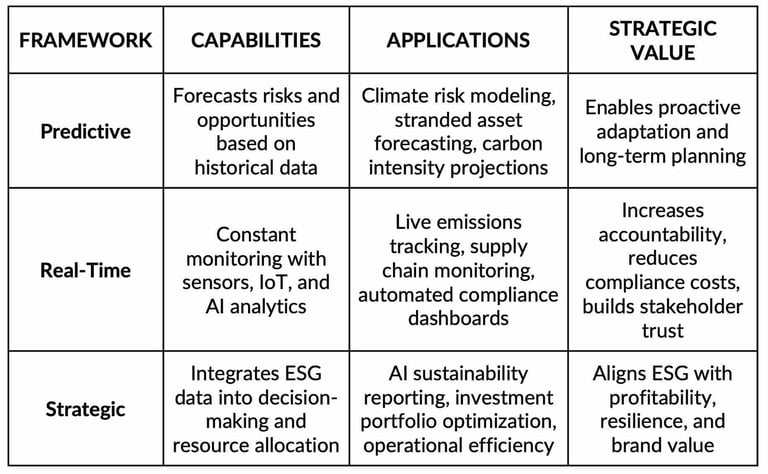
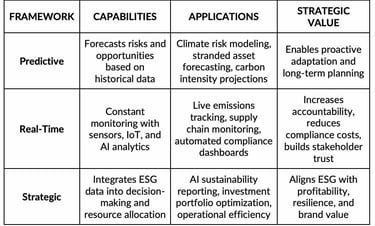
While each approach has its own advantages, combining all the frameworks is key to creating a more adaptive forward-looking approach to ESG strategies. The table below aims to highlight each framework’s key capabilities, applications, and strategic significance for 2030.
CHALLENGES AND ETHICAL CONSIDERATIONS
While AI does have its benefits, there are also challenges and ethical considerations that must be overcome for organizations to truly utilize the full capability of AI-powered systems. Firstly, bias in training data can alter the results of assessments and overlook vulnerable communities. Additionally, AI systems themselves consume vast amounts of energy through the large data centers required for AI functionality with a report by Reuters showing how tech giants’ indirect emissions have risen 150% in just three years due to the rapid expansion of AI.
Furthermore, Jerome C. Glenn's latest publication also focused on underscoring how as AI systems evolve towards AGI-level capabilities, it is important that global AI governance is prioritized as without robust oversight and ethical frameworks in place, AI has the capability to exacerbate inequality or mismanage critical decisions such as disaster response or climate forecasting or many more situations which have direct impacts on the lives of thousands of people.
To overcome these challenges, AI must be used responsibly and take all ethical considerations into account when making decisions regarding AI, ensuring that AI-augmented ESG strategies account for all the indirect costs of using AI. If organizations want to be able to truly understand the opportunities and risks of using AI, they must focus on creating forecast scenarios based on the methods of think tanks such as the Millennium Project, to ensure that AI truly empowers ESG strategies.
THE JOURNEY TO 2030
Looking ahead into the future, it is clear that the path to 2030 will be shaped by how companies incorporate AI to align with ESG principles. While the tools already exist today, organizations have just started to recognize their strategic relevance and what remains is for simply more organizations to start integrating these AI frameworks into their own ESG decisions. Those who succeed in implementing these frameworks will not only be able to better anticipate and prepare for risks but will also unlock the resilience necessary to survive in a world where climate change continues to escalate, becoming leaders in a new era of innovatively sustainable enterprise.
Thevindie Premarathne is a Research Assistant(Intern) for the Millennium Project’s South Asia Foresight Network (SAFN) in Washington, D.C.