Asanga Abeyagoonasekera Calls for Moral Governance in an Age of AI and Global Uncertainty
Trust should be viewed not merely as a social issue, but as a strategic indicator of national resilience and stability
NEWS
SAFN
6/25/2026
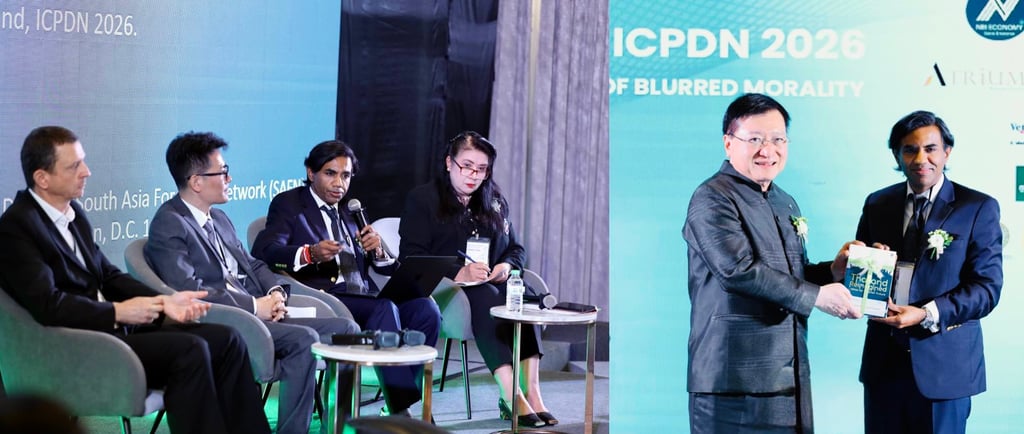
Pic L-R: Dr. Adam Burke, Prof. Dr. Zhou Zhanggui, Prof. Asanga Abeyagoonasekera, Lt Gen. Dr. Wandee Tosuwan, Prof. Kriengsak Chareonwongsak.
Bangkok, Thailand | 25 June 2026 Sri Lankan geopolitical analyst Prof. Asanga Abeyagoonasekera, Executive Director of the South Asia Foresight Network (SAFN) at The Millennium Project in Washington, D.C., addressed the International Conference on Peace upon Morality, Development and Nation-Building (ICPDN 2026) in Bangkok, 19th June 2026, emphasizing that the greatest challenge facing societies today is not technological or geopolitical—but moral.
Speaking on “The Architecture of Trust: Moral Governance in a Fragmented World,” Prof. Abeyagoonasekera highlighted the growing crisis of trust between citizens and institutions, particularly among Generation Z across South Asia and beyond.
“As artificial intelligence becomes increasingly integrated into governance and everyday life, the challenge before us is not merely technological—it is profoundly ethical,” he stated. “Without ethics, governance becomes transactional. Without trust, peace becomes temporary.”
Drawing on findings from his newly published book, Winds of Change(2026), based on three years of research across South and Southeast Asia, Prof. Abeyagoonasekera noted a recurring pattern of declining public trust in institutions, particularly among younger generations seeking accountability, transparency, and ethical leadership.
He further noted that geopolitical risk factors depicted in the Economic Crime and Geopolitics Index (ECGI) are clear indicators for understanding rising social and political concerns and declining trust in institutions among ordinary citizens. According to Prof. Abeyagoonasekera, governance weaknesses, corruption, economic insecurity, disinformation, and geopolitical pressures increasingly shape public perceptions of legitimacy and accountability. He argued that trust should be viewed not merely as a social issue, but as a strategic indicator of national resilience and stability.
The session was moderated by Lt. Gen. Dr. Wandee Tosuwan and featured distinguished panelists Dr. Adam Burke, Senior Director of Peace and Stability at The Asia Foundation, and Prof. Dr. Zhou Zhanggui, Director of the OSS International Collaboration Mechanism (Center) and Research Fellow of Overseas Safety and Security Programs at Zhejiang University, China.
During the conference, Prof. Abeyagoonasekera presented his academic paper, The Architecture of Trust: Moral Governance in an Age of AI and Geopolitical Fragmentation, for publication in the International Relations Institute (IRI) Journal. The paper introduced a Moral Governance Framework built on four pillars: Ethical Governance, Institutional Trust, State Resilience, and Human Security. The framework argues that ethical governance strengthens trust, trust strengthens resilience, and resilience protects human security. Concluding his remarks, he stressed that trust remains the foundation of sustainable peace and effective governance. “In an age of uncertainty, what we must preserve above all is trust,” he said.
The South Asia Foresight Network (SAFN), operating under The Millennium Project in Washington, D.C., served as an academic partner of ICPDN 2026. The conference was developed by Prof. Kriengsak Chareonwongsak, Senior Policy Advisor and Chairman of the Nation-Building International Institute (NBII), Thailand, and has evolved into a leading international platform for dialogue on morality, development, peace, and nation-building.
Media Contact
South Asia Foresight Network (SAFN)
Email: southasiafutures@gmail.com