Between a Ceasefire and an Empty Wallet: From the Strait to the Street
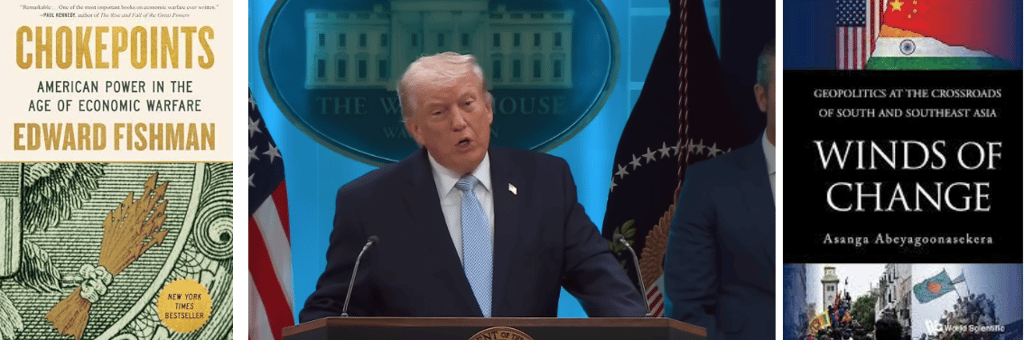
Two books appeared in February 2026, just days before the war: Chokepoints and Winds of Change. They arrived quietly, almost unnoticed, yet they now read like warnings written ahead of time.
COMMENTARIES
Asanga Abeyagoonasekera
4/10/20265 min read
BANGKOK – The ceasefire arrives not as peace, but as silence. A pause imposed by exhaustion, not reconciliation. Yesterday, the world was told that strength had prevailed—that force, applied with precision and conviction, had restored order to a disorderly region. The language is familiar. It speaks of objectives met, of enemies diminished, of a world made safer. Yet beneath this narrative lies another truth, quieter and more persistent: the world has not become safer; it has become more fragile.
For thirty-eight days, war was conducted with mathematical clarity. Targets were counted, systems dismantled, capacities erased. The machinery of a state reduced to numbers—percentages of destruction, sorties flown, assets neutralized. It is the modern form of war: clinical, distant, efficient. A war without ambiguity, we are told. A war that ends not in stalemate, but in victory.
And yet, the ceasefire does not end the consequences. It merely displaces them, shifting their weight from the battlefield to other fronts.
Far from the theater of conflict, in the ports of South and Southeast Asia, in the narrow corridors of trade and finance, the war continues—unseen, unacknowledged. It travels not with missiles, but with prices. Not with soldiers, but with scarcity. Oil routes tighten, shipping costs rise, currencies strain. The Strait, which has now reopened, was never merely a passage for ships; it was an artery of stability. Its disruption did not create chaos—it revealed it.
Two books appeared in February 2026, just days before the war: Chokepoints and Winds of Change. They arrived quietly, almost unnoticed, yet they now read like warnings written ahead of time. Chokepoints, by Edward Fishman, describes a world where power no longer depends only on geography, but on invisible systems—financial networks, shipping insurance, technology flows—points of control that can be closed without a single shot fired. Winds of Changeturns instead to the Indo-Pacific, where geography still matters, where corridors are built and rebuilt, where the axis of power shifts between larger forces. Both ask the same question, from different directions: how long can systems built on control endure, and what remains when they begin to fail?
The temporary closure of the Strait of Hormuz offered an answer, though not a reassuring one. Nearly 90 percent of the energy that passes through that narrow passage is destined for Asia. When it slows, everything else follows. Prices rise. Supply chains fracture. Governments begin to ration not only fuel, but also expectations. Growth, once assumed, becomes conditional. Stability, once promised, reveals its fragility. Even Kristalina Georgieva warned of what she called “the unthinkable”—a phrase that now feels less like caution and more like description.
But there is something more immediate than systems, more urgent than indices. There is the human condition beneath these abstractions—quiet, enduring, and increasingly strained.
I write this between Sri Lanka and Thailand, where the crisis is not abstract. It arrives at a moment that should have been different. In Sri Lanka, the Sinhala and Tamil New Year approaches; in Thailand, Songkran draws near. These are seasons of return. Workers leave cities with small gifts, traveling back to villages where they are remembered.
Yet this year, the movement hesitates.
A worker in Thailand tells me he will not go home. “I have no money to see my family, not even to buy anything for my children.” There is no anger in his voice. Only a quiet recognition. Around him, drivers wait for passengers who do not come, factories reduce hours, and the informal economy—so central across the Indo-Pacific—reveals its truth: there is no certainty here, only continuity without guarantee.
The Economic Crime and Geopolitics Index (ECGI) speaks of systemic risk, of external shocks, of interconnected vulnerabilities. But beneath these terms lies a simpler reality: people already living at the edge were pushed closer to it. The 38-day war did not need to arrive with force. It arrived through cost.
Across the Indo-Pacific, the pattern repeats. In India, factories fall silent. In Vietnam, rising costs erase what little margin remains. In Japan and South Korea, concern grows over shortages yet to be fully seen but already anticipated. And in Sri Lanka, memory returns before recovery is complete. In 2022, there was no money to buy fuel. Now, there is money—but still no fuel. The distinction is technical. The consequence is not.
Queues reappear. And with them, a familiar unease.
It has been days since the Strait closed. Had it remained so for sixty more, the crisis would have changed its nature. It would no longer be economic alone. It would become political. The Philippines has already declared an energy emergency. Others may follow—not as decision, but as inevitability. Public anger rarely traces its origins to distant wars. It settles instead on what is near: the state, the system, the failure to provide.
The ECGI reveals how this pressure accumulates. Since November 2025, risk has widened across the region. Thailand has moved into high-risk territory; Indonesia and the Philippines remain there. What was once fragmented is becoming continuous—a corridor of vulnerability stretching across South and Southeast Asia.
There is, too, a quieter contradiction. In Sri Lanka, reform appears on paper. Corruption perceptions improve. Yet the ECGI reveals a different truth: risk remains high, even extreme. Governance failures persist where they matter most—in energy, in procurement, in oversight. These are not isolated incidents, but patterns. When external shocks arrive, they do not create weakness. They expose it.
In Washington, where strategy is articulated and operations defined, this dimension remains distant. The language is one of objectives and outcomes, of capabilities and deterrence. It is a language of power. But power, when projected globally, carries consequences that are not evenly distributed.
The Indo-Pacific does not experience war as victory or defeat. It experiences it as pressure.
A decision taken in one capital reverberates through many others. Not in equal measure, but in disproportionate impact. The strongest absorb the shock. The weakest internalize it.
There is a moral weight to this asymmetry, though it is rarely acknowledged. The celebration of strength does not account for the fragility it produces elsewhere. The declaration of victory does not measure the cost borne by those who were never part of the conflict, yet remain bound to its consequences.
The ceasefire, therefore, is not merely a geopolitical development. It is a moment of relief—subtle, almost invisible to those who measure outcomes in strategic terms. But for many, it meant the possibility of returning to routine. To movement. To the fragile continuity of daily life. A bus ride regained. A market visit resumed. A small economy of survival, momentarily stabilized.
The conclusion is not dramatic, but it is difficult to avoid. Geopolitical disruption is outpacing reform. The Indo-Pacific is entering a phase where energy insecurity, institutional fragility, and economic crime converge. This is no longer a matter of isolated national problems. It is systemic.
The books were warnings. The crisis is confirmation.
And somewhere, between a reopened strait and an empty wallet, a man decides he cannot go home for the New Year. In that decision lies the true measure of geopolitics—not in doctrine or power, but in its quiet, human cost.
The ceasefire has given something back.
Not victory. Not resolution.
But time.
And for millions, time is the only currency left.
This op-ed was initially published by Global Strat View in Washington,D.C. https://www.globalstratview.com/between-ceasefire-and-an-empty-wallet/