Independent Geopolitical Gaze on South and Southeast Asia
The book is not the collection of hollowed hypothetical logics with vested political and geopolitical orientations, it is the genuine scholarly volume with field research, in-person talks to the people in power supported by rich references, constructive citations and enriching endnotes.
BOOK REVIEW
Birat Anupam
6/8/20264 min read
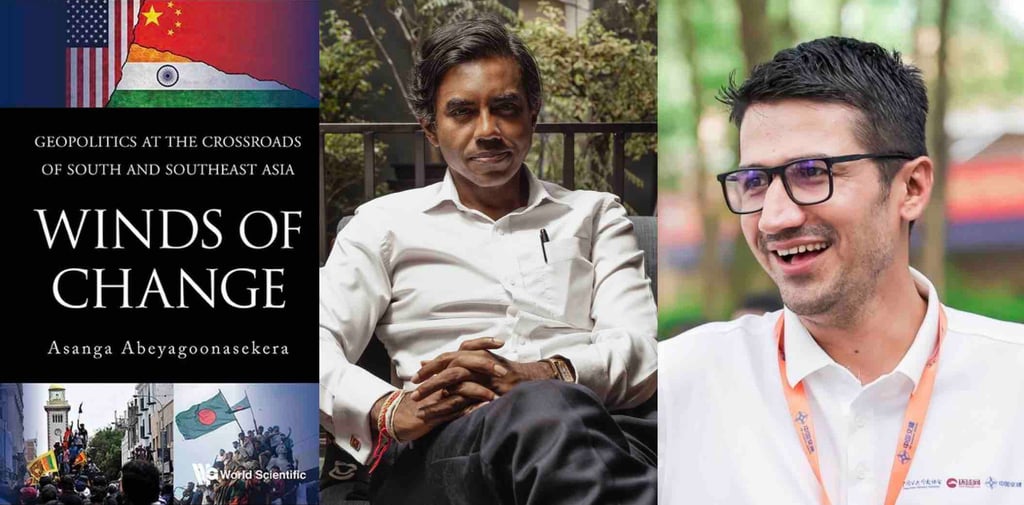
Pic: Asanga Abeyagoonasekera, Birat Anupam.
Winds of Change:Geopolitics at the Crossroads of South and Southeast Asia https://doi.org/10.1142/14462 | March 2026 | Pages: 348 | World Scientific Publishers Singapore (author):Asanga Abeyagoonasekera | Available: Hardcover, Softcover. Kindle | https://www.worldscientific.com/worldscibooks/10.1142/14462?srsltid=AfmBOorPv5w7MESJcu17JwyIEnJr_4XxtW5y1FST7XR-ZHq8DsfMXDNF#t=aboutBook
In my tiny friend circle in Kathmandu, we have a belief that for an independent scholarly South Asian perspective, there are only three countries- Nepal, Sri Lanka and Maldives. What we believe is- Indian has hegemonic nature, Pakistanis are historically anti India, Bangladeshi has anti Pakistani sentiment and Bhutan is extremely pro-India.
Having read the fresh volume 'Winds of Change' authored by Sri Lankan public intellectual Asanga Abeyagoonasekera proved our belief true. His book gives truly an independent geopolitical gone on the region. Asanga has touched upon South Asia and Southeast Asian geopolitical currents. Historically, as a Sri Lankan Asanga deserves to write on both regions. Once a British military base for South East Asia Command, Sri Lanka is also a member of South Asian Association for Regional Cooperation (SAARC). He has toured to countries of various political orientations- from Buddhist Sri Lanka and Cambodia to the communist Vietnam to Islamic-oriented Bangladesh.
Having worked as a top figure of Government-run think tanks like Institute of National Security Studies under Ministry of Defense from 2016 to 2020 and in Lakshman Kadirgamar Institute under Ministry of Foreign Affairs, he knows inside stories of Sri Lanka. He has made footfalls to various countries like China, India, Vietnam, Bangladesh, Cambodia, Thailand, Nepal, among others, for his book which. In addition, he is the only non-Indian Washington-based think tank for South Asia for which a US State Department official questioned his, ''Are you the only Executive Director of a South Asia unit who isn't Indian?'' These are his extra valid credentials to pen such book. That's why he doesn't sound like India-centric. Neither he sounds like anti-China or pro-West in his book. He doesn't buy other's logic and puts his own. For instance, he defines China's BRI as 'a practical extension of China's GCI, bringing Gramsci's cultural hegemony into economic and infrastructural realms.'' He summarizes India's uneasiness of growing Chinese presence in its immediate neighborhood and its unwillingness to give privileged space for the US. He writes, ''India has realized it cannot possibly balance China's growing influence on its own, nor can it afford having the Unites States leave the region.'' He also pinpoints drawbacks of US presence inn the South Asia and writes, ''In South Asia... Washington focus feels narrow shaped by a myopic, India-centric lens that overlooks the region's complexities.'' On Washington myth, he writes, ''From where I stand, in Washington DC, the fear for China is exaggerated, manufactured in rooms where perception outweighs reality.''
His firsthand interactions to people in power and various noted scholars make the book more authentic unearthing the ongoing three major geopolitical tides generated by China, India and the United States in South Asia and Southeast Asia. Former Sri Lankan President Maithripala Sirisena asked his, ''Will the Americans establish their military base in Sri Lanka when they vacate Diego Garcia?'' Ousted Sri Lanka President Gotabaya Rajapakse told him that it was 'CIA' who removed him something similar to what Hasina has said publicly.
He compares successful BRI story in Cambodia and unpopular in Sri Lanka. Sri Lanka's former state minister for foreign affairs Tharaka Balasooreiya told him, ''The Chinese did not force us with the loans; we wanted the loans. The issue was we di not have proper long-term business models. It's unfair to accuse China and say there is a debt trap.'' Cambodian scholar and economist Dr. Kimlong Chheng told him, ''No other nation will give us this volume of funds that China has given.'' A Colombo-stationed Chinese diplomat questioned him- ''Is Sri Lanka an independent nation? You won independent from British in 1948; are you independent from India today? India thinks the Indian Ocean is their ocean.'' Enraged by Sri Lanka's denial for Chinese research vessel at the pressure of India, the Chinese diplomat further said, ''You didn't see Indian submarines? What if we had a submarine visiting Sri Lanka?'' These firsthand expressions and questions help understand the regional ripple effects of geopolitical plays by two superpowers (US and China) and the regional power (India). However, the author pictures India's diminished presence in its extended neighborhood like Vietnam and Cambodia.
While talking on ongoing geopolitical trend of India and China, Asanga digs into their pursuits of civilizational roots of these two 'civilizational states'. He notes China's geopolitical triad of security, civilization and prosperity via various initiatives like GSI, GCI and GDI. He brings out India's Hindutva-heavy statecrafts like 'principle of Ram' as talked by India's Minister for External Affairs Jaishankar in his book 'Why Bharat Matters.'' From Deng Xiaoping's 'hide strength, bide time' to Xi Jinping's 'shared future- a global leadership role with Chinese characteristics' and from Dona'd Trump's 'Make America Great Again' to Narendra Modi's 'Make India Great Again' of the 'Aatmanirbhar Bharat' (self-reliant India).
Despite being a book focused on South Asia and Southeast Asian, Asang has given more priority to Sri Lanka which is a shortcoming to the book. Still, Sri Lankan territorial waters lies in the amalgamation of various unilateral and multilateral geopolitical tides like India's 'Neighborhood First' and 'SAGAR', China's 'BRI', America's 'Indo Pacific Strategy' and 'QUAD' grouping of the United States, Japan, Australia and India. The book gives bigger space to the US, China and India. However, little space is given for Russia which is investing in nuclear power plants in Bangladesh and Japan which has invested in Nepal's strategic tunnel road in the capital city. Russia's growing media footprints in the region with RT and Sputnik India headquartered in New Delhi could have been another glance at the growing geopolitical grounds of Russia. EU's enhanced block engagement with India and its vicinities are not mentioned extensively.
The book is not the collection of hollowed hypothetical logics with vested political and geopolitical orientations, it is the genuine scholarly volume with field research, in-person talks to the people in power supported by rich references, constructive citations and enriching endnotes. This is the must-read package for students of diplomacy, enthusiastic of geopolitics, policymakers based in New Delhi, Beijing, Washington and Brussels.
Birat Anupam is a Kathmandu-based Nepali journalist writing mostly on tourism, diplomacy, and the environment. @birat_anupam