Sri Lankan Geopolitical Analyst Asanga Abeyagoonasekera Highlights Rise of Gen-Z Movements Across South and Southeast Asia at Kathmandu Regional Conference
“Change begins like a wind—unseen at first, but impossible to ignore once it gathers force. Across South and Southeast Asia, that wind is now unmistakable. The question is no longer whether change will come, but whether we are prepared to give it direction.”
NEWS
SAFN
5/11/2026
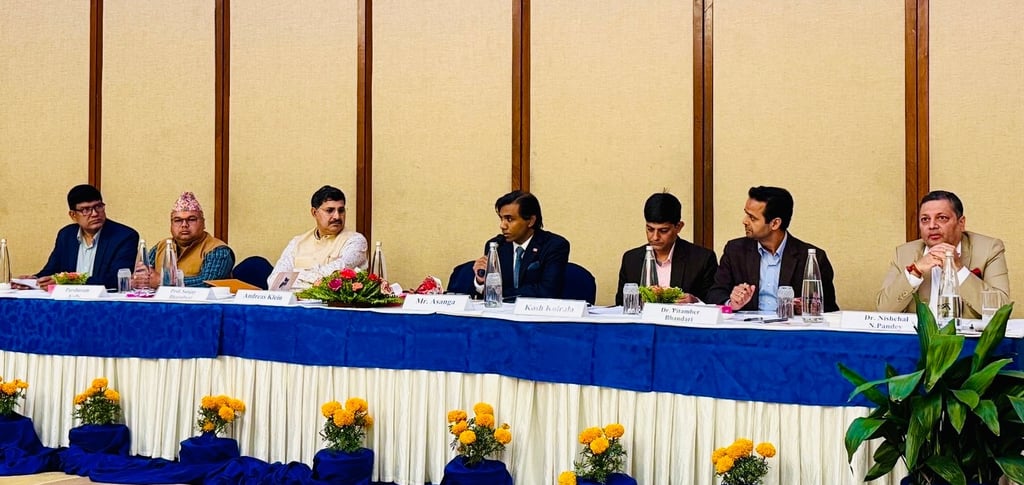
Kathmandu, Nepal, May 11, 2026 — Prominent South Asian geopolitical analyst, author, and Executive Director of the South Asia Foresight Network (SAFN) in Washington, DC, Asanga Abeyagoonasekera delivered a keynote intervention at the launch of the regional report on Youth Movements in South and Southeast Asia, warning that the region is undergoing a profound political transformation driven by Gen-Z frustration over corruption, democratic erosion, elite capture, and economic instability.
The conference, organized by COSATT in partnership with the Konrad Adenauer Stiftung, brought together scholars, journalists, policymakers, civil society representatives, and youth leaders from across South and Southeast Asia in Kathmandu on May 9th, 2026 to discuss emerging political transitions shaped by youth-led movements.
The event commenced with welcome and opening remarks by Dr. Nishchal N. Pandey, followed by the official launch of the report by all panelists. The conference also featured remarks by Prof. Sanjay K. Bharadwaj of Jawaharlal Nehru University, senior journalist Kosh Koirala from Republica National Daily, Dr. Pitambar Bhandari of Tribhuvan University, Asst Prof. Chhatra Karki of Kathmandu University, as well as paper contributors Shreeti KC and Janak Pokharel.
In his remarks, Abeyagoonasekera praised the efforts of COSATT and KAS for convening what he described as a “timely and historically important regional reflection on youth political mobilization.”
“I have worked with COSATT and KAS for more than a decade while serving in both government and private sector think tanks,” he noted. “Over the years, I have clearly understood the pivotal role these institutions play in strengthening democratic dialogue in the region. Today’s publication is a testament to that long-term regional commitment.”
Abeyagoonasekera drew significant attention to parallels between youth uprisings in Sri Lanka, Bangladesh, Nepal, and parts of Southeast Asia, arguing that the protests are not isolated incidents but part of a larger structural crisis between states and citizens.
Referencing his latest book, Winds of Change, which has gone out of print across much of the region due to high demand, he stated that three years of field research across South and Southeast Asia revealed recurring themes of corruption, inequality, democratic decline, and youth exclusion from governance.
The book includes interviews not only with protestors and youth leaders, but also with leaders removed from office during political upheavals, including former Sri Lankan President Gotabaya Rajapaksa. According to Abeyagoonasekera, both Rajapaksa and former Bangladeshi Prime Minister Sheikh Hasina alleged external influence behind their political downfall, although many young activists reject such narratives and instead point to policy failures, corruption, and undemocratic governance as the primary causes of public anger.
Discussing Sri Lanka’s 2022 Aragalaya uprising, Abeyagoonasekera emphasized that the movement was driven largely by Gen-Z citizens frustrated by corruption, constitutional centralization of power, economic collapse, and elite capture of the state. He revealed that during his contribution as a Senior Advisor to Sri Lanka’s governance and political diagnostic process connected to the IMF framework, corruption and democratic erosion consistently emerged as key drivers of youth frustration.
One of the most compelling moments of his speech came when he recounted personally interviewing the young Sri Lankan who created the famous protest hashtag #GoHomeGota2022, later shortened to #GotaGoHome. The hashtag, first created in London in August 2021 by an individual with no political affiliation, eventually became the defining digital slogan of the uprising that led to the removal of the Sri Lankan president and government.
“What began as a simple digital expression evolved into one of the most powerful symbols of political resistance in modern South Asian history,” Abeyagoonasekera stated. “This is the nature of political change today—decentralized, networked, digital, and often unpredictable.”
He further noted that many of the youth leaders who played instrumental roles during the uprising neither hold positions of power nor receive recognition under the new political order. The young activist who created the original hashtag currently faces legal proceedings in Sri Lanka, including a travel ban imposed during the previous regime.
Abeyagoonasekera stressed that today’s youth movements are increasingly shaped through digital platforms and social media ecosystems, where activism can spread across borders within hours. Similar trends, he argued, are now visible from Sri Lanka and Bangladesh to Nepal and ASEAN states.
Abeyagoonasekera also highlighted findings from the Economic Crime and Geopolitics Index (ECGI), a Washington-based index developed under his leadership that tracks large-scale corruption, public trust deficits, and geopolitical financing influences across the region. He noted that the ECGI has become an increasingly recognized monitoring tool featured in regional media, including in the Philippines, and argued that such tools are essential in helping governments respond constructively to youth grievances before they escalate into systemic crises. He further stated that the ECGI will be expanded with global experts and discussed at the upcoming Cambridge University Economic Crime Symposium this August.
Drawing from interviews conducted in Manila, he cited public frustration over alleged “ghost projects” and more than USD 10 billion in missing flood control funds as further evidence that corruption remains a common trigger behind youth-led political mobilization across the region.
During his visit to Kathmandu, Abeyagoonasekera also gave an exclusive interview to prominent Nepali journalist Birat Anupam of Shilapatra News. The discussion focused on the rise of Gen-Z political movements captured in Winds of Change, as well as the broader geopolitical challenges currently confronting South and Southeast Asia.
Despite acknowledging the transformative power of mass movements, Abeyagoonasekera cautioned that protests alone cannot sustain governance.
“Movements can shake systems, but they cannot govern them on their own,” he said. “The transition from protest to policy is the defining challenge of our time.”
He emphasized the importance of strengthening institutions, including reforms recommended under the IMF governance diagnostic framework, as the only sustainable path toward achieving the accountability and systemic reforms demanded during protest movements.
Abeyagoonasekera also referred to the recent suicide of a former CEO of SriLankan Airlines who had been implicated in a large-scale aircraft procurement corruption scandal during the Rajapaksa administrations, describing it as a stark reminder of how economic crime deeply impacts society and governance.
He noted that the Sri Lankan government under President Anura Kumara Dissanayake is now strengthening independent institutions and accountability mechanisms aimed at enhancing judicial independence and transparency. He further observed that political developments in Nepal, Bangladesh, and Sri Lanka demonstrate a broader regional transition away from entrenched elite political structures toward newer actors representing legislative and democratic change.
Concluding his address, Abeyagoonasekera reiterated a central theme from Winds of Change:
“Change begins like a wind—unseen at first, but impossible to ignore once it gathers force. Across South and Southeast Asia, that wind is now unmistakable. The question is no longer whether change will come, but whether we are prepared to give it direction.”
For media contact: contact@southasiaforesight.net , southasiafutures@gmail.com